Sometimes I feel like the narrator on the old Rocky and Bullwinkle Show. "When we last saw our intrepid heroes..." It's a privilege to serve as narrator in our journey through these exciting Bible stories!
Yesterday we saw the Lord commission Joshua to lead the people after Moses' death. God told him to take the people into the land and conquer it. Three times He told Joshua to be strong and courageous. He would need all the strength and courage that the Lord can give him for this mission! The Lord reassured him again in 3:7, "Today I will begin to exalt you in the sight of all Israel, that they may know that, as I was with Moses, so I will be with you." Just as God exalted Moses with the parting of the Red Seas, He will now exalt Joshua through the parting of the Jordan River.
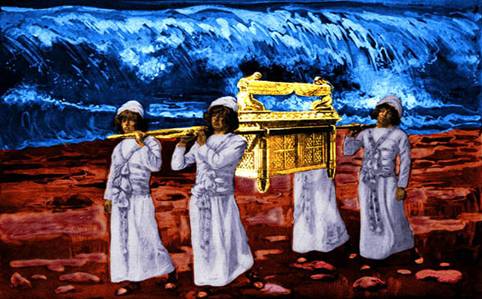
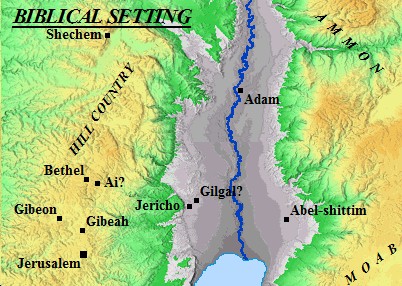
When I saw the Jordan River during my time in the Holy Land, it wasn't very impressive. It looked to be about as wide and deep as the Mahoning River in our area. But this was after years of drawing it down for irrigation. In Joshua's day it was bigger. And in addition, they were standing before the river at the time of harvesting the spring grains. All the snow melt from Mt. Hermon and the other mountains in that region flow down into the Jordan River and at that time it would grow to a mile wide, full of churning muddy water. The Lord told Joshua to send the priests, carrying the Ark of the Covenant, to the front of the people, and to walk into the river. As soon as their feet touched the Jordan it suddenly peeled back clear to Adam, a city about eighteen miles north of their position! Earthquakes have been known to cause landslides that dam up the Jordan. However He did it, the Lord made a wide path for Israel to cross into the Promised Land! Joshua told them to give the Ark a wide birth, coming no closer to it than 2,000 cubits (about half a mile). It would take at least half a day for 2 million people and their flocks to cross. Here's a map that illustrates the scope of what God did:
After they crossed Joshua sent twelve men, one from each tribe, to pick up stones from the river and stack them at Gilgal to serve as a monument to what God had done for them that day. Years later, when children saw and asked, the parents used that teachable moment to tell them, "Israel passed over this Jordan on dry ground. For the Lord your God dried up the waters of the Jordan for you until you passed over, as the Lord your God did to the Red Sea,which he dried up for us until we passed over, so that all the peoples of the earth may know that the hand of the Lord is mighty, that you may fear the Lord your God forever."
Rahab, the prostitute who hid the two spies, told them that everyone in Jericho was scared to death of the Israelites. They had heard of how the Lord had parted the Red Sea, and how they had crushed Og and Sihon, the mighty kings east of the Jordan. (Joshua 2:9-11). The rulers and commanders thought that the flooding Jordan would keep the Israelites away for a while, and that when they did cross they would be vulnerable to attack. But now they watched the Jordan dry up and that great nation crossed in a day! Israel was now camped at Gilgal, just six miles away! But they were determined not to go down without a fight! It would take a long time for the Israelites to breach their high, thick walls. Or so they thought.... Stay tuned!
Paul wrote in 1 Corinthians 10:1-2, "For I do not want you to be unaware, brothers, that our fathers were all under the cloud, and all passed through the sea, and all were baptized into Moses in the cloud and in the sea..." When we think of baptism we think of the sacrament we celebrate according to the Lord's command. We were baptized into Jesus Christ. Baptism is a symbol of our identification with Him. He has claimed us, and we are His. In a similar way the crossing of the Red Sea and the Jordan identified the people with Moses and Joshua. God established them as His appointed leaders.
I've been thinking and praying a lot lately about Christian leadership. I need to be a leader like Moses and Joshua. These men led from their knees through their time with the Lord at the Tent of Meeting. It's a difficult time for the church and as with the Israelites there's a lot of anxiety about the future. Pray for me and for our Elders and Deacons! Pray that we will have the courage and boldness to lead you in a godly way.
Here's a song I found that retells today's passage:
Yesterday we looked at the golden calf incident, just one of many times when the people of Israel broke faith with their God while in the wilderness. Yet for a period of two years He was preparing them to enter the Promised Land and take what He had promised to Abraham 600 years earlier. During this time Moses received and then taught God's Law to the people. Finally the day came when they arrived at Kadesh, on the border of Canaan. Moses sent twelve spies, one from each of the tribes, to explore the land and gather intelligence on the inhabitants. God told His people that He was bringing them into "a land flowing with milk and honey," and that was no exaggeration. They brought back a single cluster of grapes that was so big they draped it over a pole and it required two men to carry it. But that's not all the spies reported. "The land, through which we have gone to spy it out, is a land that devours its inhabitants, and all the people that we saw in it are of great height. And there we saw the Nephilim (the sons of Anak, who come from the Nephilim), and we seemed to ourselves like grasshoppers, and so we seemed to them." (Numbers 13:32-33). Only two of the spies, Moses' personal assistant Joshua and Caleb from the Tribe of Judah. They pleaded with everyone to take heart and remember that the Lord is with them. But the people were afraid. Again they wished they were back in Egypt and were ready to choose a new leader who would take them back. The Lord rebuked them and said, "How long shall this wicked congregation grumble against me? I have heard the grumblings of the people of Israel, which they grumble against me. Say to them, 'As I live, declares the Lord, what you have said in my hearing I will do to you: your dead bodies shall fall in this wilderness, and of all your number, listed in the census from twenty years old and upward, who have grumbled against me, not one shall come into the land where I swore that I would make you dwell, except Caleb the son of Jephunneh and Joshua the son of Nun.'" (Numbers 14:27-30) The Lord sent them back into the wilderness until everyone over the age of twenty had died. God would prepare the next generation to take the Promised Land. Let's think about this for a moment. Are we afraid to follow God's leading? What might that cost us?
Even Moses didn't get to enter the land. Remember his temper? One day when Israel was grumbling because there was no water, God told him to speak to the rock and water would come forth. But Moses had had enough of their griping and instead yelled "How long do I have to put up with you, you rebels?" and he took his staff and struck the rock. The Lord honored Moses' leadership and gave Israel water, but He was not pleased with what Moses had done. The Lord said, "Because you did not believe in me, to uphold me as holy in the eyes of the people of Israel, therefore you shall not bring this assembly into the land that I have given them." (Numbers 20:12) Moses' little temper tantrum distracted the people from looking to God as their Lord. Moses pleaded with the Lord to let him enter, but He was firm. He did allow Moses to see the land from atop Mt. Nebo on the east side of the Jordan River. Moses died there on Nebo, and the Lord Himself buried His servant there.
The Lord told Joshua that Moses was dead and that he now was Israel's leader. The Lord said to Joshua, "Head 'em up, move 'em out! Go into the land and take it. Don't be afraid- trust in Me and I'll see you through." That's what Joshua wanted to do years earlier, and now he has the all-clear. But those giants they saw haven't gotten any shorter. Their walled cities haven't gotten any weaker. Humanly speaking, the odds are very much against Israel taking the land from all of the "ites." But since when have the odds meant anything when God is with us?
The Lord tells Joshua three times in verses 6 through 9 to be strong and courageous. The word strong comes from a root that means rigid or unbending. Stand firm, Joshua! Don't bend and break in the face of the enemies overwhelming power. And be courageous. The word means to be bold, to push forward no matter what. Anything repeated three times in the Bible, especially in such a short space, has to be very important. At Kadesh so many years ago the peoples' hearts melted when they heard that there were giants in the land. Joshua and his fellow spy Caleb didn't let that stop them. They were ready to go in and take the land. But the people weren't. Joshua must project strength and courage, even at times when he doesn't feel strong and courageous, for the sake of the people. We see at the end of the passage that the people encourage Joshua to be strong and courageous, too. This is more than just a football coach's halftime pep talk. This is the God of the universe, promising to back Joshua's play.
God calls each of us to be strong and courageous. That's easier said than done! We, too, face giants in our lives. We're tempted to back off, to play it safe, to go along to get along. The same God who told Joshua to conquer tells us to do the same. Romans 8:37 says, "No, in all these things we are more than conquerors through him who loved us." 2 Corinthians 10:3-5 says, "For though we walk in the flesh, we are not waging war according to the flesh. For the weapons of our warfare are not of the flesh but have divine power to destroy strongholds. We destroy arguments and every lofty opinion raised against the knowledge of God, and take every thought captive to obey Christ."
Tomorrow we'll see this courage in action, and God's help supporting courage, as Israel crosses the Jordan.
I pray this video of the Melbourne, Australia Mass Choir will fire you up as much as it did me. I couldn't get it to embed, so here's the link. Aussies got soul! Who knew?
Before we begin with today's reading I'd like to touch on something I skipped over yesterday. God tells us in the second commandment not to make a carved (graven) image that represents Him. Exodus 20:5-6 says, "You shall not bow down to them or serve them, for I the Lord your God am a jealous God, visiting the iniquity of the fathers on the children to the third and the fourth generation of those who hate me, but showing steadfast love to thousands of those who love me and keep my commandments." At first glance this sounds unfair. God punishes children, grandchildren and even great-grandchildren for the sins of the parents? John Piper, the pastor of the Bethlehem Baptist Church in Minneapolis, is one of the preachers I listen to for my Sabbath. He explains it well in a blog post entitled "How God Visits Sins on the Third and Fourth Generation." It's a short article and I commend it to you. In a nutshell, Piper says "The sins of the fathers are punished in the children through becoming the sins of the children." Parents who hate God and despise the Bible will, by the example they set, pass that attitude on to their children. Piper goes on to point out "Because of God’s grace, which is finally secured by Christ, the children can confess their own sins and the sins of their fathers and be forgiven and accepted by God." This warning is not an irreversible decree dooming the following generations no matter what they do.
Now, back to the Children of Israel in the wilderness. After the Lord spoke to all the people at Mt. Sinai, God called Moses to come nearer and He gave to him some more laws to pass on to the people. Then in Exodus 24:1-2, "Then he said to Moses, 'Come up to the Lord, you and Aaron, Nadab, and Abihu, and seventy of the elders of Israel, and worship from afar. Moses alone shall come near to the Lord, but the others shall not come near, and the people shall not come up with him.'" Moses went up on the mountain and was there for forty days and nights. In the meantime Moses' young assistant Joshua waited for Moses at the foot of the mountain while Aaron went back to lead the people in Moses' absence.
After Moses had been gone a good while the people started to worry. "Where is he? We don't know what's going on. We'd better do something!" Panic-induced decisions like this one are never good ones. They came to Aaron and said, "Up, make us gods who shall go before us. As for this Moses, the man who brought us up out of the land of Egypt, we do not know what has become of him." Aaron should have calmed the crowd and assured them that Moses would return and that the God of their fathers would not desert you. But he didn't do that. Instead he asked the people to bring him their gold jewelry. He melted it down and turned it into the statue of a bull calf. Bulls were a symbol of strength and were revered in nearly every pagan culture of the time. Above is a statue of the Egyptian god Apis, whom the Israelites would have recognized.
What was Aaron thinking? Was Moses' brother and right-hand man, who had been with Moses from that very first visit to Pharaoh and had seen every miracle up close, giving up on God? I don't think so. Notice what Aaron said to the people when he revealed the statue: "When Aaron saw this, he built an altar before it. And Aaron made a proclamation and said, 'Tomorrow shall be a feast to the Lord.'" Aaron was not violating the first commandment, but rather the second. He was afraid the people would kill him and scatter. He sought to comfort and reassure them with a visual representation of the God who had delivered them, to calm them down until Moses came back.
It didn't work that way. We read "And the people sat down to eat and drink and rose up to play." This feast to the Lord quickly turned into a raucous party. Aaron had intended the golden calf to represent the God whose name is I Am. The people, however, reverted to the sensual paganism they had seen all around them. The worship of other nations' gods would always be a temptation for Israel. Why? I see two reasons. First, as we've seen today, they had trouble keeping their faith in an unseen God. And second, pagan worship is fun! Drunkenness and uninhibited sex were hallmarks of the feasts to gods like Baal and Asherah. God's law is such a buzz kill.
God told Moses what was going on down in the camp. God said, "I have seen this people, and behold, it is a stiff-necked people. Now therefore let me alone, that my wrath may burn hot against them and I may consume them, in order that I may make a great nation of you." Stiff-necked means stubborn, unwilling to learn or obey. God is ready to wipe them out and start over with Moses. He made the same promise to Moses that He made to Abraham. What an offer! Those people had been trouble for Moses from day one. He could watch them burn! But notice what Moses said in reply. He gave God two reasons not to destroy His people: First, think of the Egyptians. They and all the other nations of the earth will wonder why You brought them out here just to kill them; and second, remember the promise to Abraham, Isaac and Jacob. If you kill these people You've broken Your word. God heard Moses and relented.
But now Moses was mad, and he was coming down to deal with the situation. God had given him stone tablets with the Ten Commandments and other laws. Moses threw them down and broke them to pieces! Some have joked that Moses was the first man to break all ten commandments at once. But this is no joking matter! Moses took that golden calf, ground it up into dust, threw it into the water and made the people drink that bitter draught.
What follows just might be the funniest passage in the Bible. Moses asked Aaron, "What did this people do to you that you have brought such a great sin upon them?" Did they tie you up and pull your fingernails out? Did they tickle you? Just what did they do that was so bad that you brought them to the edge of annihilation? Aaron replied, "Let not the anger of my lord burn hot. You know the people, that they are set on evil. For they said to me, 'Make us gods who shall go before us. As for this Moses, the man who brought us up out of the land of Egypt, we do not know what has become of him.' So I said to them, 'Let any who have gold take it off.' So they gave it to me, and I threw it into the fire, and out came this calf.'" Out came this calf?!?!?!?! I don't think I need to explain just how stupid that is!
Moses saw that the people had "broken loose." They had lost all sense of restraint and propriety. That word can also be translated as naked, and that is how the King James Version renders it. Remember how Adam and Eve felt shame when they realized that they were naked? The people of Israel had in essence taken of the righteous covering of the Lord. Moses rallied those who still loved the Lord and his fellow Levites came out in force. He ordered them to bring order again. They went through the camp and killed around 3,000 people to bring the people back into control. This may seem extreme, but think of how extreme this situation is. They're in the middle of the wilderness. If they won't follow God's leadership through Moses they will all die.
Moses then went back up the mountain with a heavy heart to intercede for the people. God's heart was broken, and so was his. He prayed to God to forgive the people, and the Lord did. But the Lord also said that He would no longer hang around the camp because of the peoples' proneness to sin. Instead, Moses pitched a tent a good distance away from the camp. He called it the Tent of Meeting. He would go there to speak with God, and the cloud that led them would settle over the tent. Moses had such wonderful fellowship with God that his face would glow after he had been in His presence. Moses was unaware of it, but it scared the people who saw it, so he wore a veil when he was outside of the Tent of Meeting.
God had not given up on His people, but they weren't on the best of terms either. We'll pick up the story tomorrow.
I want to take a few moments to consider this man Moses. Remember how his life divides into three parts? First he thought he was somebody when he was a member of Egypt's royal family. Then he learned that he was really nobody during those years as a shepherd in the wilderness. Then he learned how God can use a nobody. Moses learned this last lesson really well. Numbers 12:3 says, "Now the man Moses was very meek, more than all people who were on the face of the earth." And the postscript of Deuteronomy, which Joshua probably added, says of Moses "And there has not arisen a prophet since in Israel like Moses, whom the Lord knew face to face, none like him for all the signs and the wonders that the Lord sent him to do in the land of Egypt, to Pharaoh and to all his servants and to all his land, and for all the mighty power and all the great deeds of terror that Moses did in the sight of all Israel." (Deut. 34:10-12) The secret of Moses' strength was in that Tent of Meeting, where he met with God. Jesus, the Son of God, likewise rose early and went off to spend time in prayer. Can we expect to do much for Christ if we ignore prayer? I've found that when I hurry my prayer time or skip it that I don't accomplish all that I thought I would. One of the best books on prayer is With Christ in the School of Prayer, by Andrew Murray. The link is to the Christian Classics Ethereal Library, where you can download it for free in several formats, including audio. I listened to the audio book last fall while driving back and forth to Cambridge.
I'll leave you with a song from Keith Green that sums up Israel's time in the wilderness with some humor:
On Friday we saw how God delivered Israel by parting the Red Sea. The Children of Israel crossed on dry land while their Egyptian pursuers were drowned. As you can imagine, the people were joyous and they celebrated this amazing victory. Their joy, though, was cut short when the realities of the wilderness intruded. Where will they find water for two million people and all their livestock? They grumbled against Moses- somehow this is all his fault. The Lord showed Moses how to make some bitter water drinkable and then led them to the oasis at Elim. By the time they left Elim, they were running low on food. You guessed it, they grumbled against Moses again! "Would that we had died by the hand of the Lord in the land of Egypt, when we sat by the meat pots and ate bread to the full, for you have brought us out into this wilderness to kill this whole assembly with hunger." Despite their bad attitude and lack of faith, the Lord provided for them. They went out of their tents and the ground was as white as snow! They said to each other "what's this?" The Hebrew is "man hu." So they called it manna. The Lord provided it for them each morning during their time in the wilderness. Then Israel grumbled again. They wanted more than just manna- they wanted some meat to go with it. So the Lord sent flocks of quail into the camp at evening. Did this end their grumbling? No. They definitely need an attitude adjustment and the Lord is ready to teach them.
Three months after leaving Egypt they came to Mt. Sinai, where the Lord appeared to Moses in the burning bush. The Lord told Moses to tell the people to prepare to meet Him. He told Moses to warn them not to come too close to the mountain, lest they die.
Three days later a thick cloud, accompanied by thunder and lightning, covered the top of Mt. Sinai. Then fire, smoke and the sound of trumpets came forth from the mountain. The people were terrified! Then the Lord spoke the words that we call the Ten Commandments:
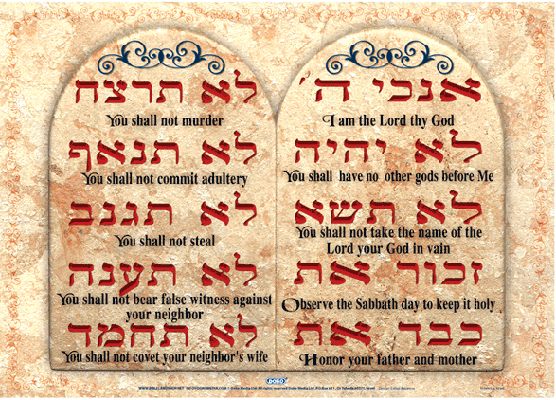
"I am the Lord your God, who brought you out of the land of Egypt, out of the house of slavery. You shall have no other gods before me." You saw lots of gods in Egypt, and you'll see lots of gods when you reach Canaan. Just remember who I am and what I've done for you. I will not tolerate rivals!
"You shall not make for yourself a carved image, or any likeness of anything that is in heaven above, or that is in the earth beneath, or that is in the water under the earth. You shall not bow down to them or serve them, for I the Lord your God am a jealous God, visiting the iniquity of the fathers on the children to the third and the fourth generation of those who hate me, but showing steadfast love to thousands of those who love me and keep my commandments." Some consider this a part of the first commandment and others as the second commandment. I agree with the latter. The distinction is that the first commandment forbids worshipping other gods while the second commandment tells us not to make representations of the one true God. The Egyptians made statues and pictures of their gods in the form of animals which illustrated each god's particular powers. The Lord is saying don't do that with Me! Nothing you can make will represent me properly and it will lead to idotaltry. Remember My name, I am who I am. The Lord says that He is jealous- He will not share His people, and will punish unfaithfulness severely.
"You shall not take the name of the Lord your God in vain, for the Lord will not hold him guiltless who takes his name in vain." The word translated as vain means empty, worthless. Do not treat My name as if it were nothing! Don't use Me to try to prove that your lies are true, and don't use My name as a swear word. Jesus told us not to swear at all, but to let our yes be yes and our no be no (Matthew 5:33-37). Does this mean that it's wrong to use God's name in a solemn oath, like courts administer to witnesses, with the right hand on a Bible, "Do you solemnly swear that the testimony you are about to give is the truth, the whole truth, and nothing but the truth, so help you God?" And what about the president and other leaders who take their oath of office swearing "so help me God" with their right hands on the Bible? Some conscientious Christians say this is wrong, that our yes and no, always given in the presence of God, is all that is required. But I think that for very serious matters like these it is appropriate. What is not appropriate is saying things like "I swear to God" when we're trying to convince someone that we're speaking the truth. In my experience when someone says that, they're usually NOT telling the truth. As Jesus said, our character should be such that yes means yes and no means no when we speak.
"Remember the Sabbath day, to keep it holy. Six days you shall labor, and do all your work, but the seventh day is a Sabbath to the Lord your God. On it you shall not do any work, you, or your son, or your daughter, your male servant, or your female servant, or your livestock, or the sojourner who is within your gates. For in six days theLord made heaven and earth, the sea, and all that is in them, and rested on the seventh day. Therefore the Lord blessed the Sabbath day and made it holy." The Sabbath, a day of rest, is God's gift to us. Was God worn out after His great work of creation so that He had to take a day off? No. He is infinite and didn't need to rest. He was setting an example for us, for our benefit. Jesus said, "The Sabbath was made for man,not man for the Sabbath. So the Son of Man is lord even of the Sabbath." God doesn't need rest, but WE do. We need to step back from our busy lives to catch our breath and worship. God did not intend the Sabbath to be a burden, but by Jesus' time the Pharisees had come up with over 5,000 rules for observing the Sabbath. Modern Christians can be almost as pharisaical. I heard of a man who was an Old UP (United Presbyterian Church of North America- Faith Church's original denomination) who would not mail a letter on Friday or Saturday because it would likely be sorted on Sunday. Not only would he not buy a Sunday newspaper, he wouldn't buy one on Monday either because it was laid out on Sunday. Those kinds of excesses, though, are a distant memory, if even that. We live in a 24/7/365 world, and it's far easier to list what's not open than what is. We're ignoring God's good gift of the Sabbath, and we're the poorer for it. Now there are certain jobs which require working on Sunday- police, fire, health care and the like. These are what the Westminster Confession calls "works of mercy and necessity." Jesus healed on the Sabbath and we need to care for others on the Sabbath.
"Honor your father and your mother, that your days may be long in the land that the Lord your God is giving you." The word translated as honor is literally "regard as heavy." It means don't take your parents lightly. They spent years caring and providing for you. They deserve your respect. I heard a Rabbi preach on this commandment. He pointed out that God commands us to honor our parents, not to love them. Some parents aren't so lovable. Nevertheless we are to honor them. As the Apostle Paul points out, this is the first commandment with a promise (Ephesians 6:1-3). The promise is a long and prosperous life. The family is the bedrock of civilization. We see the effects of broken homes in our society and the terrible cost it entails.
"You shall not murder." When we were looking at God's covenant with Noah in Genesis 9 I commented briefly on this commandment. The King James Version famously translates it as "Thou shalt not kill." The Hebrew words refers to an individual killing another individual, whether accidental or premeditated. The Law of Moses made provision for accidental killing, or manslaughter, to go to a city of refuge where his case would be heard, and where he could stay if it was an accident. For premeditated murder, though, the penalty was death by stoning. Different words are used for execution of criminals, warfare and the slaughter of animals for food or sacrifice. God made us in His image, and each human being is precious in His sight.
"You shall not commit adultery" This commandment protects the sanctity of marriage. The word adultery comes from the word adulterate. Adulterate means to dilute something by mixing in something else. Adulteration reduces quality. Gasoline with water in it will mess up your car's engine. Adultery dilutes marriage. We saw in Genesis 1 and 2 that God made us male and female. Together we reflect the full image of God. In marriage we become "one flesh," a relationship that illustrates Christ's relationship with His church (Ephesians 5:22-33). Two's company, three's a crowd. We must guard our hearts against temptation, and that's not easy in our world today. The best book I've seen on this subject is Hedges: Loving Your Marriage Enough to Protect It, by Jerry Jenkins. The best hedge of all is to keep working at your marriage, growing more deeply in love all the time.
"You shall not steal." Don't take what's not yours. The Bible establishes the right to have private property. This goes beyond things like shoplifting or embezzlement to everyday things like giving your employer a full eight hours of work for eight hours' pay.
"You shall not bear false witness against your neighbor." This sounds like it comes from a formal courtroom setting, and it does. We discussed the taking of oaths to compel truthfulness earlier. Life and property depend on truthful testimony, which is why we call lying under oath perjury and punish perjurers. Beyond this, though, is a duty to protect our neighbor's good name. Rumors and gossip damage innocent people every day. We must not be a party to them! If a problem arises, discuss it with the person, not with everyone else. The tales we bear take on a life of their own and grow way out of proportion. So take Barney Fife's advice and "Nip it in the bud!"
The last commandment is "You shall not covet your neighbor's house; you shall not covet your neighbor's wife, or his male servant, or his female servant, or his ox, or his donkey, or anything that is your neighbor's." Envy is a synonym for covet. We see what others have, think it's nicer that what we have, and we grumble and resent not just our seemingly better-off neighbor but God who hasn't blessed us as much as we think He should. God promises to provide for us and teaches us that contentment is true riches. Nothing robs us of the joy of life like envy, and nothing poisons our relationships as much as covetousness. James 4:1-3 says, "What causes quarrels and what causes fights among you? Is it not this, that your passions are at war within you? You desire and do not have, so you murder. You covet and cannot obtain, so you fight and quarrel. You do not have, because you do not ask. You ask and do not receive, because you ask wrongly, to spend it on your passions." Covetousness is a strong acid that eats away at life.
Here's a video with a familiar face and a catchy way to remember the commandments. Be the first to identify the host:
Sunday, February 9, 2014
SUNDAY'S SERMON:
I Am
Exodus 3:1-15
Here is today's sermon for those of you who couldn't be with this morning:
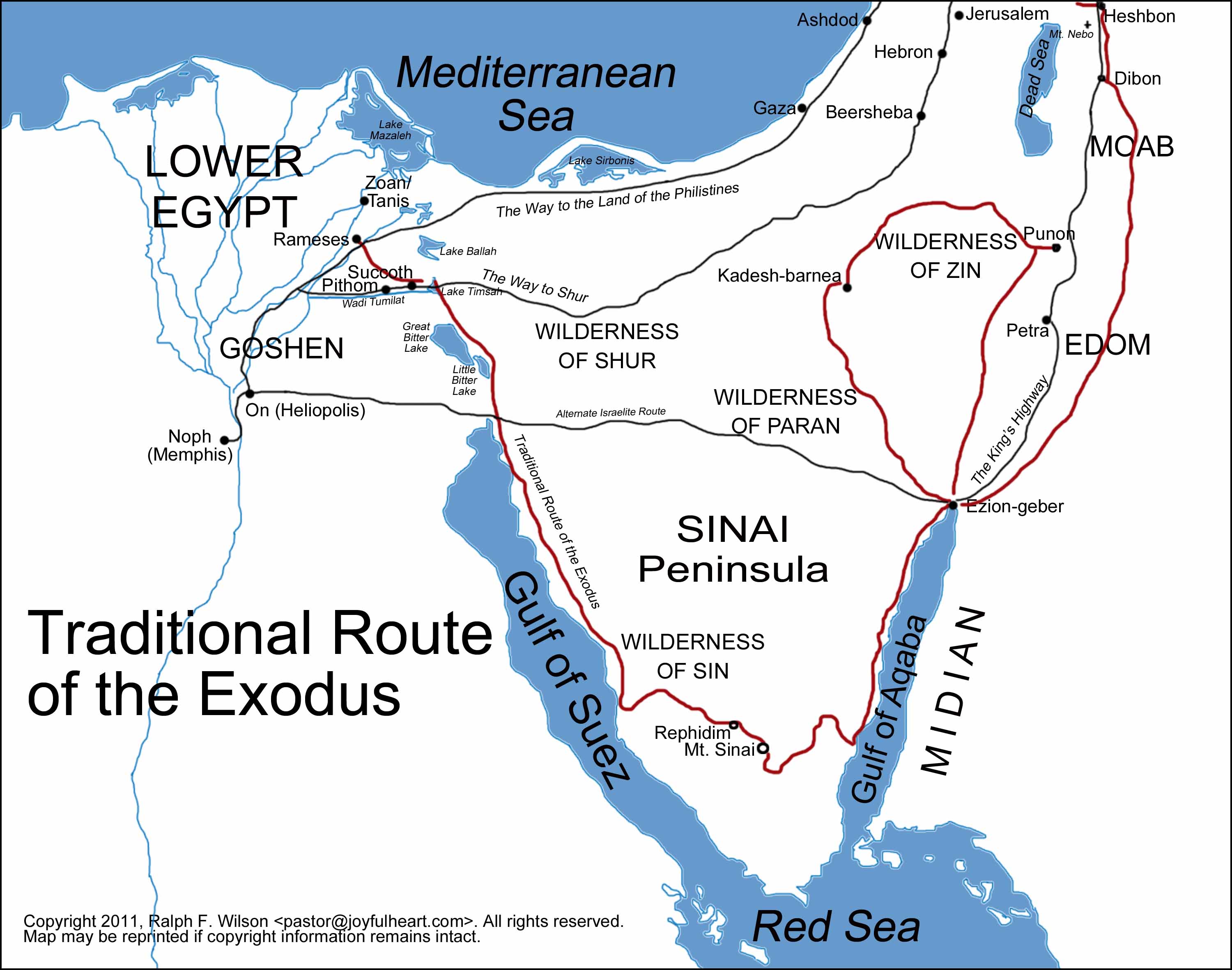
The Children of Israel are on their way back home after a 430-year stay in Egypt! But how are they going to get there? The same God who freed them from captivity with "a strong arm and mighty hand" is not going to abandon them now. He will lead them all the way. It will help if we have a map in front of us:
The quickest route to Canaan would have been along the Mediterranean coast. This was a major trade route, the road that took Joseph to Egypt many years before. It was level and well-marked. Had they gone this way they would have reached Canaan in a matter of days. But God didn't lead them that way. They would have run into the Philistines and their strong army. These newly-freed slaves would be afraid and want to return to Egypt.
So God took them south, toward the Red Sea. The exact route is difficult to pin down. The words translated Red Sea could also be translated as Sea of Reeds. There was a series of large lakes which were drained when the Suez Canal was built. Some suggest that they crossed one of those lakes. Skeptics point out that some of these lakes are quite shallow and they Israelites could have waded across. Others argue that Israel went to the upper end of the Gulf of Suez and crossed the Red Sea at that point. Recently a number of scholars have proposed that Israel crossed the Red Sea on the other side of the Sinai Peninsula, at the opening of the Gulf of Aqaba. It can be confusing to sort through all of this, and it's really not critical to what God wants to teach us.
God led them with a pillar of cloud by day and a pillar of fire by night. The pillar of fire enabled them to keep moving at night. Soon they found themselves camping at the shore of the Red Sea.
Meanwhile, back in Egypt, Pharaoh is having second thoughts about releasing the Hebrews. They were a massive workforce, and without them Pharaoh's building projects would lie unfinished. He had to get them back! This was all part of God's plan. He said that He would harden Pharaoh's heart once more so that he would pursue Israel. Then He would show His glory with an even greater deliverance. Pharaoh called up his army, with over 600 chariots (the tanks of that day) and headed out.
Israel was camped at the shore of the Red Sea. Soon a cloud of dust appeared on the western horizon. It was the Egyptians coming after them! The people were afraid. They complained to Moses (the first, but definitely not the last, time they grumbled against their leader). "Are there no graves in Egypt? Is that why you brought us out here to die? We'd have been better off in Egypt!" Moses replied, "Fear not, stand firm, and see the salvation of theLord, which he will work for you today. For the Egyptians whom you see today, you shall never see again. 14 The Lordwill fight for you, and you have only to be silent." (14:13-14)
The Lord told Moses to lift up his hands toward the Red Sea and tell the people to head toward the beach, ready to cross. The pillar of cloud and fire moved behind the camp and stood as a wall that the Egyptians could not cross. Then God sent a strong east wind that blew all night which parted the waters! The people crossed over- 600,000 men, all the women and children and foreigners who had attached themselves to Israel, and their flocks. This must have been an impressive sight! I remember the first time I saw Cecil B. DeMille's The Ten Commandments, The rendering of the Red Sea crossing was truly spectacular! I'm sure it didn't hold a candle to the real thing.
The Egyptians saw what was happening. Israel was crossing the sea on dry ground! They couldn't attack, though, because God stood between them and His people. When the last of the freed slaves had crossed, the pillar lifted and Pharaoh ordered his troops to advance. The sea was still parted and they drove their chariots into it. The pillar of cloud hovered over the Egyptians and threw them into a state of confusion. The chariots started bogging down. Then it suddenly occurred to the Egyptians that they were in the middle of the sea! "Let's get out of here!" But then the Lord told Moses to raise his hands over the water once more. The Red Sea came back together, drowning the Egyptians. God had delivered His people once again!
Our passage ends with these words: "Israel saw the great power that the Lord used against the Egyptians, so the people feared the Lord, and they believed in the Lord and in his servant Moses." And they all lived happily ever after. I'm afraid not! There's a lot more to the story, and we'll pick it up next week as we look at the Ten Commandments.
Like yesterday's passage, what we've read today is about God's amazing power to save His people. He devastated Egypt with the ten plagues, and now He has drowned the Egyptian army that pursued His people. Jeremiah 32:17-21 says, "Ah, LordGod! It is you who have made the heavens and the earth by your great power and by your outstretched arm!Nothing is too hard for you. You show steadfast love to thousands, but you repay the guilt of fathers to their children after them, O great and mighty God, whose name is the Lord of hosts, great in counsel and mighty in deed,whose eyes are open to all the ways of the children of man, rewarding each one according to his ways and according to the fruit of his deeds.You have shown signs and wonders in the land of Egypt, and to this day in Israel and among all mankind, and have made a name for yourself, as at this day. You brought your people Israel out of the land of Egypt with signs and wonders, with a strong hand and outstretched arm, and with great terror." If God can do things like this, can't He also help us? He certainly can, and He promises that He will. All He asks of us is to trust Him.
If God wanted to get His people's attention, He succeeded! They saw what He had done for them and they were in awe. They also had a deep respect for Moses, the man they had complained against not long before. They know that God is with him and they have confidence in his leadership (at least for the moment). 1 Corinthians 10:1-2 says, "For I do not want you to be unaware, brothers, that our fathers were all under the cloud, and all passed through the sea, and all were baptized into Moses in the cloud and in the sea..." Moses was God's man! Yet Israel would grumble against him and against his brother Aaron repeatedly. More about that next week. Suffice it to say that God raises up leaders for His people, and His people must respect those leaders.
Why do we question God? Why do we think we know more than He does? He is all-powerful, all-wise and all-loving. Where else can we turn but to Him?
Here is one of my favorite songs from my college days, when I was young in the faith. It's based on the song that Moses taught the people in Exodus 15 as they celebrated their deliverance:
Yesterday we saw the devastation of the ten plagues the Lord visited upon the Egyptians. The Lord said that He would harden Pharaoh's heart so that he would refuse to release Israel. Romans 9:17 says, "For the Scripture says to Pharaoh, 'For this very purpose I have raised you up, that I might show my power in you, and that my name might be proclaimed in all the earth.'"
We didn't discuss the last, and most terrible, of the ten plagues yesterday. I'd like to do that now, as it leads into our passage today. God will strike the firstborn children of Egypt, from the poorest shacks clear up to Pharaoh's palace there will not be a single house spared. Again, this will not strike the Hebrews in Goshen. This time, however, they must do something to receive God's protection.
Moses told the people of Israel to get ready! Tomorrow's the day we leave. Gather in your homes for one last meal. Eat it with your shoes and coat on and your staff in your hand. Slaughter a lamb and paint some of its blood over the doorposts of your houses. This will be a sign for the Angel of Death, who is coming to strike the firstborn of Egypt, to "pass over" your houses. Then roast the lamb and eat it with unleavened bread and bitter herbs. This was the first Passover, one of the three feasts the Lord would ordain for His people (the others are Pentecost and Booths).
At midnight the Angel of Death struck the firstborn of Egypt, including Pharaoh's heir. A terrible wailing was heard all through the land, and Pharaoh called for Moses and Aaron. He was finally ready to let the people go. The Egyptians were very anxious for them to leave because by this time they were very afraid of them and their God. Moses told the people to ask the Egyptians for their gold, silver and precious gems. The Egyptians were only too happy to comply, just so long as they left!
The Children of Israel headed up and moved out! There were about 600,000 men and an unspecified number of women and children. A "mixed multitude" of people went with them, Egyptians and people of other nations who had come to trust in the God of Abraham, Isaac and Jacob. All the livestock they had went with them. Think of it! Somewhere between 1-1/2 and 2 million people, plus all those animals. Everyone was on foot. I would hate to be at the end of that parade- think of the dust!
We're told in our passage that Israel left Egypt 430 years TO THE DAY that Jacob and his family arrived. God was honoring the promise He made to Abraham so long ago. Genesis 15:13-16 says, "Then the Lord said to Abram, 'Know for certain that your offspring will be sojourners in a land that is not theirs and will be servants there, and they will be afflicted for four hundred years. But I will bring judgment on the nation that they serve, and afterward they shall come out with great possessions. As for you, you shall go to your fathers in peace; you shall be buried in a good old age. And they shall come back here in the fourth generation, for the iniquity of the Amorites is not yet complete.'"
The Hebrews have left Egypt and are on their way to the Promised Land. But it's far from smooth sailing. Tomorrow we'll look at the parting of the Red Sea.
The story of the Passover is the story of God's power to redeem His people. The Jews to this day celebrate the Passover, joining together for a special meal (called a Seder). Jesus celebrated the Passover with His disciples. In Luke 22:15 we read, "And he said to them, 'I have earnestly desired to eat this Passover with you before I suffer. For I tell you I will not eat it until it is fulfilled in the kingdom of God.'" The word translated "earnestly desired" is a word that is usually translated as lust. It describes any strong and overpowering desire, good or sinful. It was in this Passover meal that Jesus instituted what we call The Lord's Supper. We read on in Luke 22, "And he took bread, and when he had given thanks, he broke it and gave it to them, saying, 'This is my body, which is given for you. Do this in remembrance of me.' And likewise the cup after they had eaten, saying, 'This cup that is poured out for you is the new covenant in my blood." In a few hours the authorities would arrest Jesus. The Roman governor Pontius Pilate would order His death by crucifixion. Jesus' body would be broken and His blood poured out. 1 Corinthians 5:7-8 says, "Cleanse out the old leaven that you may be a new lump, as you really are unleavened. For Christ, our Passover lamb, has been sacrificed. Let us therefore celebrate the festival, not with the old leaven, the leaven of malice and evil, but with the unleavened bread of sincerity and truth."
The lamb's blood painted on the doorposts was a picture of what Jesus would do many years later. 1 Peter 1:17-21 says. "And if you call on him as Father who judges impartially according to each one's deeds, conduct yourselves with fear throughout the time of your exile, knowing that you were ransomed from the futile ways inherited from your forefathers, not with perishable things such as silver or gold, but with the precious blood of Christ, like that of a lamb without blemish or spot. He was foreknown before the foundation of the world but was made manifest in the last times for the sake of you who through him are believers in God, who raised him from the dead and gave him glory, so that your faith and hope are in God."
Lord willing, I'd like for us to share in a Passover Seder on Maundy Thursday (April 17). While for our Jewish friends it is a celebration and remembrance of how God brought His people out of bondage in Egypt, it is also for us a celebration and remembrance of how God brought us out of our slavery to sin and death through His Son.
Rabbi Joe Black has to be the coolest Rabbi ever! Here's his Passover song, performed with the help of some little assistants.