Wednesday, March 19, 2014

DAY FORTY-EIGHT: 
Daniel in the Lions' Den 
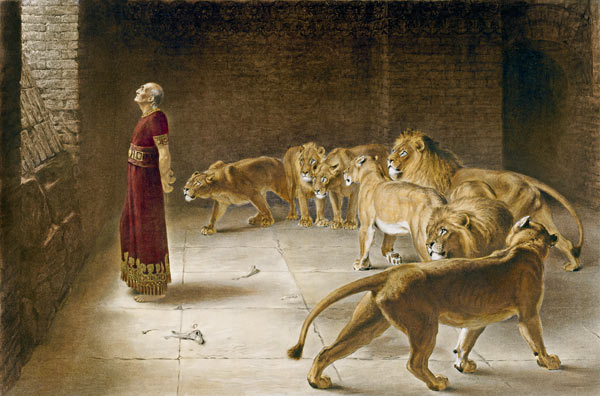

Daniel in the lions' den is one of the most familiar and beloved Bible stories. Like David and Goliath, it captures our attention with an amazing example of faith. Before we get to today's passage let's look at Daniel's life.

Daniel was one of the 10,000 high-ranking Jews taken to Babylon in 597 BC. Nebuchadnezzar ordered that any promising young men be taken and groomed as future counselors and leaders. They would be schooled in all the knowledge and wisdom of the Middle East and steeped in Babylonian culture. They even received new Babylonian names. Daniel was renamed Belteshazzar (Prince of Bel, one of Babylon's many gods). Daniel's three friends Hananiah, Mishael and Azariah became Shadrach (Great Scribe), Meschach (Guest of the King) and Abednego (Servant of Nebo, another god). The king also ordered that they be fed with the same food that he ate, the very best meat and wine.  Daniel and his three friends could not eat that food. It would defile them before God. Daniel approached the servant in charge of their care and asked if they could just eat vegetables and drink water. When the servant balked, Daniel suggested a two-week trial. When Daniel and his friends looked stronger and healthier than the rest, they were allowed to continue with their diet. The Lord was with them and they excelled.

There were, however, some bumps in the road. Nebuchadnezzar commissioned a huge golden statue of himself and ordered everyone to bow before it. Daniel's three friends refused. They would bow only to God. The king was so enraged that he ordered his furnace heated seven times hotter and that they be thrown in alive. They still refused, and into the furnace they went. But they weren't incinerated! They started walking around in the furnace and a fourth man joined them, one that Nebuchadnezzar said looked like "a son of the gods." Now who might that be???? They came out of the furnace unharmed, not even smelling of smoke! Their response to the king's command to bow before his image is powerful: "O Nebuchadnezzar, we have no need to answer you in this matter. If this be so,our God whom we serve is able to deliver us from the burning fiery furnace, and he will deliver us out of your hand, O king. But if not, be it known to you, O king, that we will not serve your gods or worship the golden image that you have set up."

In time Babylon fell to the up and coming Persian Empire. Daniel was there that last night, when King Belshazzar saw a hand appear and write four words on the wall: "mene, mene, tekel, parsin). Daniel read the handwriting on the wall and its message of doom. Daniel found favor with King Cyrus and his sub-regent Darius the Mede, and he continued to serve as a high official.

Today's passage begins with Darius appointing Daniel as administrator over all 120 satraps, or provinces, of the empire. The other high leaders were jealous of Daniel and sought to bring him down. They looked for dirt but couldn't find any. Finally they said, "We shall not find any ground for complaint against this Daniel unless we find it in connection with the law of his God." They knew that Daniel was faithful to the God of Abraham, Isaac and Jacob, and that he paused to pray three times a day. They hit upon a plan. They would go and stroke Darius' ego and tell him how god-like he was. Then they'd get Darius to issue a decree that for the next thirty days no one may pray to any god or ask anything of anyone other than him. Then they'd have Daniel right where they wanted him! They would catch him praying and report him to Darius. Once issued, a law of the Medes and the Persians was irrevocable, even by the king himself (we saw this in the Book of Esther when we studied it). Sure enough, Daniel prayed to God. He didn't do it in secret, either. As was his custom, he opened a window facing west and bowed toward Jerusalem. His enemies heard him praying, and with glee they went off to report Daniel's crime. Darius knew he had been tricked, and looked for a way out. He tried all day to find a loophole, but found none. Finally, as the sun was setting, the jealous officials reminded Darius that he had to carry out the sentence on Daniel. Darius had no choice but to throw Daniel into a den of lions that were poorly fed and ready to devour anyone thrown to them. Darius said to Daniel, "May your God, whom you serve continually, deliver you!"

The king spent a sleepless night, wondering and worrying about Daniel. He was so upset that he canceled his usual evening of entertainment. He was up at the crack of dawn, a very unusual thing for someone who was used to partying into the wee hours. He couldn't wait to see how Daniel fared with those lions. After his servants uncovered the den, Darius cried out, "O Daniel, servant of the living God, has your God, whom you serve continually, been able to deliver you from the lions?" And Darius heard Daniel answer! "O king, live forever! My God sent his angel and shut the lions' mouths, and they have not harmed me, because I was found blameless before him; and also before you, O king, I have done no harm." I love the painting at the top of the page! Daniel is just standing there in the ray of sunlight coming into the pit, while all the lions look like scared house cats! Darius ordered that Daniel be hauled up and his accusers and their families thrown in. They didn't even reach the floor before the lions tore them to shreds. They got their meal after all! Darius was duly impressed and no doubt Cyrus heard about it. Perhaps this is what led him to issue the decree to send the exiles back to rebuild Jerusalem and the Temple.

Daniel went on to serve through the second year of Cyrus. By this time he must have been in his eighties if not his nineties. There's a lot more in the book that bears his name. The Lord revealed Israel's future to Daniel in the last half of the book.

Once again we're confronted with an example of courage in the face of danger. The Lord told Joshua to be bold and courageous when he looked at the walled cities filled with well-armed warriors. We saw Elijah face down 450 priests of Baal. We saw David take down the giant Goliath with just a sling and a stone. God is the same today as He was then. We can have that same courage today. We have to remember, though, that our real enemies are not the people who mock us for our faith or discriminate against us because of it. We're in an unseen battle with supernatural forces. Paul wrote in Ephesians 6:10-12, "Finally, be strong in the Lord and in the strength of his might. Put on the whole armor of God, that you may be able to stand against the schemes of the devil. For we do not wrestle against flesh and blood, but against the rulers, against the authorities, against the cosmic powers over this present darkness, against the spiritual forces of evil in the heavenly places." When Daniel saw a vision that troubled him, he fasted and prayed to learn the meaning. After three weeks and angel came to him. He told Daniel, "Fear not, Daniel, for from the first day that you set your heart to understand and humbled yourself before your God, your words have been heard, and I have come because of your words. The prince of the kingdom of Persia withstood me twenty-one days, but Michael, one of the chief princes, came to help me, for I was left there with the kings of Persia, and came to make you understand what is to happen to your people in the latter days. For the vision is for days yet to come." (Daniel 10:12-14) Rulers, authorities, spiritual forces of evil in the heavenly places. These are our real enemies. Goliath was fearsome, but he couldn't hold a candle to Satan himself and his legion of demons. Yet we're told not to be afraid! Paul goes on Ephesians 6 to tell us about the full armor of God. Be persistent in prayer and trust in our God who is bigger than anything that faces us!

What better way to end our study than with a rendition of Dare To Be A Daniel?


Tuesday, March 18, 2014

DAY FORTY-SEVEN: 
The Call of Jeremiah 

Jeremiah being lowered into a cistern.

Jeremiah is a man with whom I can identify. He shares more of his heart in his book than any other prophet. Reading this book is like reading David's Psalms. In addition to the book that bears his name, he also wrote the short Book of Lamentations. We often overlook this little book, but we cheat ourselves when we do.

The book begins, "The words of Jeremiah, the son of Hilkiah, one of the priests who were in Anathoth in the land of Benjamin, to whom the word of the Lord came in the days of Josiah the son of Amon, king of Judah, in the thirteenth year of his reign. It came also in the days of Jehoiakim the son of Josiah, king of Judah, and until the end of the eleventh year of Zedekiah, the son of Josiah, king of Judah, until the captivity of Jerusalem in the fifth month." Jeremiah's father was a priest, and Jeremiah was expected to follow that career path. But like John the Baptist, whose father was also a priest, God had a different plan for Jeremiah. He would be a prophet and speak God's Word to wayward Judah. He began in the thirteenth year of Josiah, which would have been around 636 BC. Josiah became king when he was just eight years old, so God's call came to Jeremiah when Josiah was still a young man of twenty-one.When he was just seventeen he began to seek after the Lord. He tore down the altars to Baal and the other gods and he began much-needed repairs of the Temple. In those early ears Jeremiah had a willing listener in Josiah. But when Josiah was killed in battle his son Jehoiakim became king and started to undo what his father had done. Then the Babylonians came and Jerusalem surrendered. Jehoiakim was carried into exile with the first wave along with Daniel and Ezekiel. His younger brother Zedekiah became king in his place. He rebelled against Nebuchadnezzar and the Babylonians came, destroyed Jerusalem and the Temple and carried the bulk of the population off to exile.

The Lord spoke to Jeremiah as a young man and said, "Before I formed you in the womb I knew you, and before you were born I consecrated you; I appointed you a prophet to the nations." Wow! God knew Jeremiah even before he was born, and had a plan for his life! That's mind-blowing. But the same is true for us. Psalm 139:13-16 says, "For you formed my inward parts; you knitted me together in my mother's womb. I praise you, for I am fearfully and wonderfully made. Wonderful are your works; my soul knows it very well. My frame was not hidden from you, when I was being made in secret, intricately woven in the depths of the earth. Your eyes saw my unformed substance; in your book were written, every one of them, the days that were formed for me, when as yet there was none of them." And Ephesians 1:4-6 says, "...even as he chose us in him before the foundation of the world, that we should be holy and blameless before him. In love he predestined us for adoption as sons through Jesus Christ,according to the purpose of his will, to the praise of his glorious grace, with which he has blessed us in the Beloved." Even before God created the world, He knew me! He knew you! All we can do is praise God for His amazing love!

Jeremiah responded to God much the same way as Moses. "Ah, Lord God! Behold, I do not know how to speak, for I am only a youth." The prospect of standing before the whole nation and declaring God's Word scared him! And that fear is not totally unfounded, as he knows that many will hate him for the message he brings. But the Lord replied, "Do not say, 'I am only a youth';
for to all to whom I send you, you shall go, and whatever I command you, you shall speak. Do not be afraid of them, for I am with you to deliver you, declares the Lord." Then the Lord touched Jeremiah's mouth and said, "Behold, I have put my words in your mouth. See, I have set you this day over nations and over kingdoms, to pluck up and to break down, to destroy and to overthrow, to build and to plant." The Lord made Jeremiah an offer he couldn't refuse! He was now a prophet of the God of Israel, and would speak for Him for the next fifty years.

The Lord revealed to Jeremiah that He would not relent in His judgment on Judah. Nevertheless, God still tried to woo His people back. "Thus says the Lord: 'What wrong did your fathers find in me that they went far from me, and went after worthlessness, and became worthless?'" (2:5) "Has a nation changed its gods, even though they are no gods? But my people have changed their glory
for that which does not profit. Be appalled, O heavens, at this; be shocked, be utterly desolate, declares the Lord, for my people have committed two evils: they have forsaken me, the fountain of living waters, and hewed out cisterns for themselves, broken cisterns that can hold no water." (2:11-13)

After Josiah's death Jeremiah probably felt like he was talking to a brick wall. First Jehoiakim and then Zedekiah cared nothing for the things of God. Jeremiah came before Zedekiah when he was surrounded by false prophets who were proclaiming that the exiles would be back within two years. Jeremiah wore a yoke on his neck, and declared that Judah must not rebel but rather submit to Babylonian rule. The Lord had revealed to him that the exile would last 70 years. Zedekiah preferred the counsel of his hundreds of false prophets to the word of a true prophet of God. After this Zedekiah and the other leaders of Judah viewed Jeremiah as a traitor. He had to go into hiding and deliver God's word to the king in written form. Zedekiah took the scroll, cut it up and threw it in the fireplace. Then he had Jeremiah beaten and arrested. At first he was held in prison, but at one point lowered down into an empty cistern, left there to die. But in a rare show of character, Zedekiah ordered that he be pulled out of the cistern and put back in jail. Jeremiah was freed when the Babylonians came and destroyed the city.

A prophet had what might be the worst job of all time. They spoke truth to power and they paid a price. Jeremiah poured out his complaint to God: "O Lord, you have deceived me, and I was deceived; you are stronger than I, and you have prevailed. I have become a laughingstock all the day; everyone mocks me. For whenever I speak, I cry out, I shout, 'Violence and destruction!'
For the word of the Lord has become for me a reproach and derision all day long. If I say, 'I will not mention him, or speak any more in his name,' there is in my heart as it were a burning fire
shut up in my bones, and I am weary with holding it in, and I cannot." (20:7-9) Further on in chapter 20 Jeremiah goes so far as to curse the day he was born! The burden was more than he could bear. But the Lord was with him as He promised.

The other prophets of Israel suffered as well. The Lord told Hosea to marry a prostitute, and then to buy her back when she left him and their children to go back to prostitution. I can't imagine the heartache Hosea felt, but he was acting out in his own life how God dealt with faithless Israel. Amos was threatened and ordered to stop prophesying. Tomorrow we'll look at the story of Daniel, and how he was thrown into a den of ravenous lions because of his faith in God. Israel consistently abused and rejected God's messengers. Jesus said in Matthew 23:29-31, "Woe to you, scribes and Pharisees, hypocrites! For you build the tombs of the prophets and decorate the monuments of the righteous, saying, 'If we had lived in the days of our fathers, we would not have taken part with them in shedding the blood of the prophets.' Thus you witness against yourselves that you are sons of those who murdered the prophets." And in a short time Israel would murder yet another prophet on a Roman cross. 

It takes courage to speak God's Word in a world that doesn't want to hear it. When I lived in Wisconsin I visited State Street, which passes through the heart of the University of Wisconsin campus. I came upon a small crowd gathered around a street preacher, who was calling his hearers to repent of their sins and to trust in Jesus. Of course there were some who mocked, But most, if they stayed there, were listening. The man was making a fool of himself in that sophisticated college setting. But then that's what we're all supposed to be- fools for Christ. Paul wrote in 1 Corinthians 4:9-10, "For I think that God has exhibited us apostles as last of all, like men sentenced to death, because we have become a spectacle to the world, to angels, and to men. We are fools for Christ's sake..." I have to confess that I'm afraid to step out for God, and if I'm afraid I'm sure you are as well. 

Yes, it will cost us to be followers of Jesus. But it's worth whatever it costs to be in God's perfect will. Dietrich Bonhoeffer wrote, "The messengers of Jesus will be hated to the end of time. They will be blamed for all the division which rend cities and homes. Jesus and his disciples will be condemned on all sides for undermining family life, and for leading the nation astray; they will be called crazy fanatics and disturbers of the peace. The disciples will be sorely tempted to desert their Lord. But the end is also near, and they must hold on and persevere until it comes. Only he will be blessed who remains loyal to Jesus and his word until the end."

Here's a little song to help you remember the promise God gives us in Jeremiah 29:11-


Monday, March 17, 2014

DAY FORTY-SIX: 
The Suffering Servant 


We turn yet another page in our tour of the Bible. This week we will consider the Prophets of Israel. Our English word prophet comes from two Greek words, pro, meaning before, for or forth, and phemi, to speak. A prophet is one who speaks forth the Word of God. We often associate prophecy with predictions of the future. And sometimes God's prophets did predict the future. But for the most part prophecy is God speaking to His people in their current circumstances, revealing His will for the here and now. From the earliest days the Lord told His people to expect prophets to come to them. Moses said in Deuteronomy 18:15 Moses said, "The Lord your God will raise up for you a prophet like me from among you, from your brothers—it is to him you shall listen." Just as Moses heard from God and relayed the message to the people, so future prophets will reveal God's words to them and guide them. We'll look at several details about the prophets and their prophecies as the week goes on.

Today we're looking at Isaiah's prophecy of the suffering servant. Before we dig in let's look at Isaiah's background. His book begins, "The vision of Isaiah the son of Amoz, which he saw concerning Judah and Jerusalem in the days of Uzziah, Jotham, Ahaz, and Hezekiah, kings of Judah." Isaiah's ministry spanned four kings and sixty years! We read of his call in Isaiah 6. He saw a vision of the Lord in the Temple, and it caused him to say "Woe is me!" He knew that he was in the presence of the Holy Lord, and he was painfully aware of his sin and uncleanness. But God called him to give His message and equipped him with what he needed to do the job. Isaiah's book spans 66 chapters and is the longest of the prophetic books. There is a sharp break between chapters 39 and 40 which has led some to conclude that someone other that Isaiah wrote chapters 40 through 66 long after he had died, making the last part of the book a "pious fraud," written either in exile or after the return from exile. Recent computer analysis of the text, however, has shown a consistency throughout the book that could only come with one author.

Now on to our text. Isaiah had foretold Judah's exile in Babylon because of their faithlessness. But now, over a hundred years before that exile, Isaiah brings words of hope from God! As the people of Judah marched toward Babylon they could take comfort in these words.  Isaiah 51:11 says, "And the ransomed of the Lord shall return and come to Zion with singing; everlasting joy shall be upon their heads; they shall obtain gladness and joy, and sorrow and sighing shall flee away." Isaiah 52:7 says, "How beautiful upon the mountains are the feet of him who brings good news, who publishes peace, who brings good news of happiness, who publishes salvation, who says to Zion, 'Your God reigns.'" Glorious stuff!

The meat of this passage is the prophecy of the "suffering servant," which is especially meaningful in Lent. This passage begins at the end of chapter 52: "Behold, my servant shall act wisely; he shall be high and lifted up, and shall be exalted. As many were astonished at you—
his appearance was so marred, beyond human semblance, and his form beyond that of the children of mankind— so shall he sprinkle many nations; kings shall shut their mouths because of him; for that which has not been told them they see, and that which they have not heard they understand." This is a prophecy of the coming Messiah, the deliverer of Israel. The people longed for the arrival of their King, believing He would free them from their bondage. And indeed there are many passages that show the Messiah in this light. Isaiah, however, is describing something entirely different. God's servant will be marred beyond recognition, beaten mercilessly. Yet He will "sprinkle" (or possibly startle) the nations and shut the mouths of their kings.

Isaiah continued in chapter 53: "Who has believed what he has heard from us? And to whom has the arm of theLord been revealed? For he grew up before him like a young plant, and like a root out of dry ground; he had no form or majesty that we should look at him, and no beauty that we should desire him. He was despised and rejected by men; a man of sorrows, and acquainted with grief; and as one from whom men hide their faces he was despised, and we esteemed him not." Isaiah knows that the thought of the Messiah as sufferer rather than conqueror was so contrary to the nation's expectations that they would find it hard to believe. This Servant would not be impressive. In fact, he'd be pretty ordinary, from a poor background. When He would speak people would hate Him.

We read on and find out why the Servant suffered: "Surely he has borne our griefs and carried our sorrows; yet we esteemed him stricken, smitten by God, and afflicted. But he was pierced for our transgressions; he was crushed for our iniquities; upon him was the chastisement that brought us peace, and with his wounds we are healed. All we like sheep have gone astray; we have turned—every one—to his own way; and the Lord has laid on him the iniquity of us all." It wasn't His own pain, but ours, that the Servant carried. The Lord laid our sins on Him, and He carried them! Through His wounds, which we deserved, hot He, we are healed from the deadly consequences of our sins.

We continue reading: "He was oppressed, and he was afflicted, yet he opened not his mouth;
like a lamb that is led to the slaughter, and like a sheep that before its shearers is silent, so he opened not his mouth. By oppression and judgment he was taken away; and as for his generation, who considered that he was cut off out of the land of the living, stricken for the transgression of my people? And they made his grave with the wicked and with a rich man in his death, although he had done no violence, and there was no deceit in his mouth." We see all of these things fulfilled in Jesus. Mark 14 records that Jesus said nothing at the hasty and illegal trial before the Sanhedrin, except that He was the Messiah. He was indeed carried off, beaten beyond recognition and then nailed to a cross. And He was with a rich man at His death. He was buried in the tomb of Joseph of Arimathea.

"Yet it was the will of the Lord to crush him; he has put him to grief; when his soul makes an offering for guilt, he shall see his offspring; he shall prolong his days; the will of the Lord shall prosper in his hand. Out of the anguish of his soul he shall see and be satisfied; by his knowledge shall the righteous one, my servant, make many to be accounted righteous, and he shall bear their iniquities. Therefore I will divide him a portion with the many, and he shall divide the spoil with the strong, because he poured out his soul to death and was numbered with the transgressors; yet he bore the sin of many, and makes intercession for the transgressors." Jesus obediently endured the judgment for our sins so that He could save us from them. Hebrews 12: 2 says, "...looking to Jesus, the founder and perfecter of our faith, who for the joy that was set before him endured the cross, despising the shame, and is seated at the right hand of the throne of God." Jesus looked past the cross to see the generations of believers who would enjoy forgiveness and great blessings because of what He did. It was all worth it! This is a story worth telling and telling again!

Ten years ago Mel Gibson released The Passion of the Christ. It portrayed the brutality of what the Jews and the Romans did to Jesus so graphically that the movie received a well-deserved R rating. But even with all the Hollywood special effects Gibson still fell short of portraying Christ's suffering and death. We can't begin to imagine the horrors of Jesus' scourging and crucifixion. You can read this article, A Physician Analyzes the Crucifixion, by C. Truman Davis, MD. Paul said in 1 Timothy 1:15, "The saying is trustworthy and deserving of full acceptance, that Christ Jesus came into the world to save sinners, of whom I am the foremost." Jesus did it all for you and for me! What else can we do but bow in awe at God's sovereign plan and praise Him?

I leave you with a beautiful hymn meditation on what Jesus did for us, O Sacred Head Now Wounded. 

Friday, March 14, 2014

DAY FORTY-FIVE: 
The Proverbs of Solomon 


Yesterday we looked at some of the broad principles of wisdom. Wisdom begins with the fear (reverence, respect, awe) of the Lord. Wisdom teaches us to trust the Lord and not lean on our own understanding. Wisdom teaches us to love good and to hate evil.

There are three classes of people in the Book of Proverbs: the wise, the "simple" and the fool. The wise person learns from the wisdom of others and has learned how to discern good from bad. The "simple" person is someone who is naive and unlearned. The simple will hopefully learn from their own mistakes and choose to learn the ways of wisdom. The fool is someone who utterly rejects God and His way. Psalm 14:1 says, "The fool has said in his heart, 'there is no God.'" Not in his head, but in his heart. The fool may acknowledge the existence of God, but lives as if God doesn't exist. There is little hope for the fool because he will not accept correction and will not learn from his mistakes.

Our passage today gives us a little slice of the Proverbs pie. Solomon gives his proverbs in the form of couplets or "two-liners." He compares and contrasts the wise and the foolish. Let's look at a few examples:

"All the ways of a man are pure in his own eyes, but the Lord weighs the spirit." (16:2)

"Better is a little with righteousness than great revenues with injustice." (16:8)

"Pride goes before destruction, and a haughty spirit before a fall." (16:18)

"There is a way that seems right to a man, but its end is the way to death." (16:25)

"Gray hair is a crown of glory; it is gained in a righteous life." (16:31)

"Better is a dry morsel with quiet than a house full of feasting with strife." (17:1)

"Whoever covers an offense seeks love, but he who repeats a matter separates close friends. (17:9)

"The beginning of strife is like letting out water, so quit before the quarrel breaks out." (17:14)

"Even a fool who keeps silent is considered wise; when he closes his lips, he is deemed intelligent." (17:28)

"A fool's lips walk into a fight, and his mouth invites a beating. A fool's mouth is his ruin, and his lips are a snare to his soul." (18:6-7)

"If one gives an answer before he hears, it is his folly and shame." (18:13)

"A man of many companions may come to ruin, but there is a friend who sticks closer than a brother." (18:24)

You see how very deep these little couplets are! We dare not speed through the Book of Proverbs. Each proverb is worthy of meditation. We find advice on relationships, finances, and governance. It's impossible to overestimate how much these words will help us in life. I encourage you to read regularly in the Book of Proverbs. There are 913 verses in the book, so if you read just two verses a day you'll finish the book in a year. Take the time to think about what you read and how you might apply this truth to your life.

It's a great tragedy that Solomon didn't follow his own wisdom. We saw earlier how he became bored with wisdom and decided to search out the appeal of folly. The Book of Ecclesiastes details his return to his senses. At first glance it seems a very depressing book, but I find lots of hope in its pages, and it's one of my favorite books of the Bible.

Solomon also wrote the Song of Solomon. Its Hebrew title is the Song of Songs. It is a beautiful expression of love between a man and a woman. Many have tried to allegorize (find symbolic meaning) in this book, and to an extent it is a picture of Christ and His Church (Ephesians 5:21 ff). The translation into English tends to tone things down, but in the Hebrew it is very sensual. In the Orthodox Jewish tradition, a man is not allowed to read the Song of Songs until he is 30 years old- he won't have the maturity to cope with it before that!

Here's a little song to reinforce an important truth from Proverbs:


Thursday, March 13, 2014

DAY FORTY-FOUR: 
Godly Wisdom 


We looked at Solomon last week. He was young and inexperienced when his father David died. God came to Solomon in a dream and asked what he wanted. Most of us would ask for lots of money or some such thing. Solomon asked instead for wisdom and understanding, so that he could govern God's people rightly. The Lord answered Solomon's prayer and gave him wisdom, along with incredible wealth. He recorded his proverbs and some proverbs from other wise men in this book for us. Let's look, then, at "The proverbs of Solomon, son of David, king of Israel."

Solomon lays out five goals for his Book of Proverbs:
  • To know wisdom and instruction,
  • to understand words of insight,
  • to receive instruction in wise dealing, in righteousness, justice, and equity;
  • to give prudence to the simple,
  • knowledge and discretion to the youth
Solomon will give both broad principles and wise advice for specific situations. Today we'll look at these principles, and tomorrow we'll see his practical advice.

The most important principle in the whole book, perhaps in the entire Bible, is verse seven of chapter one: "The fear of the Lord is the beginning of knowledge; fools despise wisdom and instruction." The word fear brings to mind synonyms like dread, terror and anxiety. But the Hebrew word also carries the sense of reverence and respect. To fear the Lord, then, is to honor and obey God. My favorite line from a movie comes from Rudy, where Father Cavanaugh tells Rudy, "Son, in 35 years of religious study, I have only come up with two hard incontrovertible facts: there is a God, and I'm not Him." This is the beginning of wisdom, to know that there is a God, infinitely greater and wiser than we are, and to know that we are not gods. With this attitude we are ready to learn God's wisdom. Fools, on the other hand, reject wisdom and instruction. They go on their merry way, doing what is right in their own eyes and reaping the consequences.

Solomon begins with a warning against following the way of sinners. Just as the serpent enticed Eve and she in turn enticed Adam, so temptation is around us everywhere. If you run around with those who despise God and have no respect for others you will regret it. "but these men lie in wait for their own blood; they set an ambush for their own lives. Such are the ways of everyone who is greedy for unjust gain; it takes away the life of its possessors." (1-18-19). Solomon also spends a lot of time in the early chapters warning against the trap of adultery. "So you will be delivered from the forbidden woman, from the adulteress with her smooth words, who forsakes the companion of her youth and forgets the covenant of her God; for her house sinks down to death,
and her paths to the departed; none who go to her come back, nor do they regain the paths of life." (2:16-19)

Instead, open your ears and listen! "Wisdom cries aloud in the street, in the markets she raises her voice; at the head of the noisy streets she cries out; at the entrance of the city gates she speaks: 'How long, O simple ones, will you love being simple? How long will scoffers delight in their scoffing and fools hate knowledge? If you turn at my reproof, behold, I will pour out my spirit to you; I will make my words known to you." It's as if wisdom is trying to sell itself to a sales-resistant world. God gives His wisdom freely, but not everyone wants to receive it. Wisdom is well worth our efforts to find it: "If you seek it like silver and search for it as for hidden treasures, then you will understand the fear of the Lord and find the knowledge of God." (2:4-5) If you saw gold bars lying on the sidewalk, wouldn't you pick them up? You'd recognize their great value. God's wisdom, worth far more than gold, is lying out in the open, in the pages of our Bibles, there for the taking!

Another very important principle is found in 3:5-8- "Trust in the Lord with all your heart, and do not lean on your own understanding. In all your ways acknowledge him, and he will make straight your paths. Be not wise in your own eyes; fear the Lord, and turn away from evil. It will be healing to your flesh and refreshment to your bones." God has told us what is good and right in His Word. The Bible is like the instruments in the cockpit of an airplane. One of the first things pilots learn is to trust the instruments instead of their eyes. Your eyes can deceive you, but the instruments will give you true readings. Believe and apply what God tells you. Don't try to make your way through this world without the Lord's guidance! Remember that the fear of the Lord is the beginning of wisdom, the start of a life well lived.

Solomon addresses "my son" eleven times in these four chapters. Solomon wrote down these words of wisdom for his own sons, and for their sons. Solomon learned wisdom at his father's knee: "When I was a son with my father, tender, the only one in the sight of my mother, he taught me and said to me, "Let your heart hold fast my words; keep my commandments, and live. Get wisdom; get insight; do not forget, and do not turn away from the words of my mouth." (4:3-5) It's so important that we teach our children God's wisdom! God intended from the beginning that our faith be passed on from generation to generation. Deuteronomy 6:4-7 says, "Hear, O Israel: The Lord our God, the Lord is one. You shall love the Lord your God with all your heart and with all your soul and with all your might. And these words that I command you today shall be on your heart. You shall teach them diligently to your children, and shall talk of them when you sit in your house, and when you walk by the way, and when you lie down, and when you rise."

We have many counselors to whom we resort for advice. We have financial advisors to help us with our investments. We have lawyers to advise and help us with matters of the law. In recent years a new type of counselor, the life coach, offers to help with life itself. God Himself is offering to be our counselor. Should we not turn to Him first and foremost. There is a place for other advisors, but none can do us more good than God. His Word helps us to navigate the rapids in the river of life, and guides us when the river forks off. 

My nominee for the best first paragraph of a novel is from Charles Dickens' A Tale of Two Cities: "It was the best of times, it was the worst of times, it was the age of wisdom, it was the age of foolishness, it was the epoch of belief, it was the epoch of incredulity, it was the season of Light, it was the season of Darkness, it was the spring of hope, it was the winter of despair, we had everything before us, we had nothing before us, we were all going direct to Heaven, we were all going direct the other way - in short, the period was so far like the present period, that some of its noisiest authorities insisted on its being received, for good or for evil, in the superlative degree of comparison only." I think those words describe our times perfectly. There are a lot of wonderful things around us. At the same time hordes of bad things vie for our attention. We need God's wisdom now as never before!

I'd like to leave you with a long audio link. Listen to as much of it as you are able and wish. The great British actor Malcolm McDowell reads the entire Book of Proverbs. Listening to his oral interpretation has helped me to understand some of the proverbs. And if the patterns on the screen distract you, turn the screen down or open another tab or window.


Wednesday, March 12, 2014

DAY FORTY-THREE: 
Praise the Lord! 


Today we look at one of the Psalms that teaches how to worship even as we engage in worshipping the Lord. The introduction is simply "Of David." No specification of what kind of Psalm it is, and no liturgical or musical directions. Just dive in!

Let's spend some time on the very first word. The Hebrew word for bless is barak. If that sounds like our president's first name, it should, because his name comes from Arabic, which is quite similar to Hebrew. A man named Baruch (from the same word) served as the Prophet Jeremiah's secretary. The word occurs 289 times in the Old Testament. It's the same word God used when He blessed Adam and Eve and told them to multiply and take dominion over the earth. It's the same word God used when He promised to bless Abraham. People bless one another as well. Isaac blessed Jacob. We read in Numbers 6:22-27, "The Lord spoke to Moses, saying, 'Speak to Aaron and his sons, saying, Thus you shall bless the people of Israel: you shall say to them, The Lord bless you and keep you; the Lord make his face to shine upon you and be gracious to you; the Lord lift up his countenance upon you and give you peace. So shall they put my name upon the people of Israel, and I will bless them.”

This word is in the piel, or intensive, mood. Piel intensifies a word. To break becomes to smash, and to step on becomes to grind under foot. What this means is don't just bless the lord, BLESS THE LORD!!!!!! Put everything you are and everything you have into blessing the Lord. "Bless the Lord, O my soul, and all that is in me bless his holy name."

Why bless the Lord? Because of what He has done for you. Don't forget His benefits:

  • He forgives your iniquity. We saw that yesterday with David. The Lord forgave him for his terrible sins, and He does the same for us through Jesus;
  • He heals all your diseases. We thank and praise Him for healing not just our bodies but also our souls and minds;
  • He redeems our lives from the pit. The Lord saves us from our addictions that carry us and our families into hell;
  • He crowns you with steadfast love (hesed, or grace) and mercy (compassion). As we saw in the 23rd Psalm, these things will follow us all the days of our lives;
  • He satisfies you with good things. He blesses you so richly you can never really count your blessings!
  • He restores your youth like the eagle. I'm wondering about this one this morning, as I was dead tired after a late night at a presbytery meeting. But I think that promise applies not just to our bodies. Paul wrote in 2 Corinthians 4:16, "So we do not lose heart. Though our outer self is wasting away, our inner self is being renewed day by day." My body may be slowly breaking down with age, but my soul grows stronger each and every day that I walk with the Lord!

Another reason to thank the Lord is because He is merciful. "The Lord is merciful and gracious, slow to anger and abounding in steadfast love. He will not always chide, nor will he keep his anger forever. He does not deal with us according to our sins, nor repay us according to our iniquities." God doesn't give us what we deserve, and I'm oh so grateful for that! He could easily justify crushing me each and every day for my sins. Yet even before I knew Him as Savior and Lord He was merciful, and His mercy is with me to this day! "For as high as the heavens are above the earth, so great is his steadfast love toward those who fear him; as far as the east is from the west, so far does he remove our transgressions from us." As Isaac Watts wrote in one of his great hymns, "He breaks the power of cancelled sin/ He sets the prisoner free/ His blood can make the foulest clean/ His blood availed for me."

We thank and praise the Lord because He is understanding. "As a father shows compassion to his children, so the Lord shows compassion to those who fear him. For he knows our frame; he remembers that we are dust." We're weak and imperfect. He could find us absolutely contemptible, but He loves us! He helps us along in our weakness and guides us along through life.

We thank and praise the Lord because while we are perishing, He is eternal. "But the steadfast love of the Lord is from everlasting to everlasting on those who fear him, and his righteousness to children's children..." In His love we will live forever with Him in His house, as Psalm 23 says, forever.

David goes so far as to command all the angels in Heaven to bless the Lord! "Bless the Lord, O you his angels, you mighty ones who do his word, obeying the voice of his word! Bless the Lord, all his hosts, his ministers, who do his will!" I don't think any angels took offense, because that's exactly what they do constantly. Revelation 4:8 says, "And the four living creatures, each of them with six wings, are full of eyes all around and within, and day and night they never cease to say, 'Holy, holy, holy, is the Lord God Almighty, who was and is and is to come!'" Jesus taught us to pray "Thy kingdom come, Thy will be done, on earth as it is in Heaven." As much as we are able within our human limitations, aided by the Holy Spirit, we must constantly give praise and thanks to the Lord.

David concludes as he began: "Bless the Lord, O my soul!" The worship service in David's Tent or in the Temple will come to an end at some point. But God's people must worship constantly. In Revelation 4 and 5 we learn the two reasons for worshipping God: He is holy, and He is worthy. He is holy because of who He is. The Lord told Moses His name: "I Am." We can name all sorts of things that He is as we rattle off an endless list of His attributes: He is omniscient (knows everything), omnipresent (everywhere at once), wise, just, merciful, etc. But in front of all of those is His name, I Am. "Bless the Lord, O my soul, and all that is in me bless His holy Name!" And we worship God because He is worthy. The word worthy comes from the word worth, and our word worship comes from this word. Worship is recognizing the "worth-ship" of God. He is worthy because of what He has done. He created all things, including us. And He has redeemed us through the blood of the Lamb. We praise Him because of His great works of creation and redemption. I love to read chapters 4 an 5 of the Book of Revelation as part of my preparation for worship. I'd have to say that they are my favorite passages in the whole Bible!

A few weeks ago I commented in a sermon about how I found worship dull when I was growing up. I came to realize that this is not a matter of worship style, contemporary vs. traditional worship, but really a matter of our hearts. Do we come to the House of the Lord with our hearts and minds primed to worship? Do we ask God to "tune our hearts to sing [His] praise?" Take some time on Saturday evening to meditate on what you'll be doing in the morning. And as you wake up on the Lord's Day begin your worship even as you're preparing to join with your brothers and sisters in God's House.

Harry Ironside said, "We would worry less if we praised more. Thanksgiving is the enemy of discontent and dissatisfaction." If we will worship God, bless Him with all we are and all we have, everything else in life will fall into place. We will have what we really need, and find out that we really didn't need the other things we thought we needed. Worship organizes our lives!

Enjoy this beautiful song, "10,000 Reasons," by Matt Redman. Enter into the Lord's presence!


Tuesday, March 11, 2014

DAY FORTY-TWO: 
Have Mercy On Me 


Today we look at Psalm 51. Let's begin with the introduction to the Psalm: "To the choirmaster. A Psalm of David, when Nathan the prophet went to him, after he had gone in to Bathsheba." We discussed David's sin with Bathsheba and all the consequences that followed last week. If you didn't get a chance to read it or would like to refresh your memory, click here to read that post. Suffice it to say that this was a very shameful chapter of David's life, one I'm sure he would have preferred not to discuss. But the first words we read are, "To the choirmaster." David wrote this Psalm intending that it be used in worship! His sin is going to be rehashed every time someone reads or sings this Psalm. Why would he do that? The only answer I can think of is that God told him to. The thing that makes the Bible stand out above all other religious texts is that it shows its heroes' negative side. We read earlier of Abraham's cowardice in passing his wife off as his sister, of Jacob's conniving treachery and now we read about David's adultery and murder. There's an old saying: "The Bible is a book that no man could write if he would, or would write if he could." The Holy Spirit inspired the human writers so that what we have in Scripture is exactly what God wants us to have.

David begins with a plea for mercy. The word mercy could also be translated as grace. David is asking for something he knows he doesn't deserve. He's asking anyway, because he knows God. He asks for mercy because of HIs "steadfast love." This is the same word we saw in Psalm 23- "Surely goodness and MERCY shall follow me all of my days." The Hebrew word chesed is one of the most beautiful and meaningful words in the Bible. It describes the very heart of God and His disposition toward us. Psalm 63:3 says that God's lovingkindness (mercy, grace and love rolled into one) is better than life itself. David is asking God, in His mercy and love, to blot out his sins.

David offers no excuses for his sin. Adam blamed Eve and Eve blamed the serpent, but David blames only himself. He knows what he has done. He violated another man's wife. He used the enemy to murder her husband and several other innocent men who were in the wrong place at the wrong time. He let down the entire nation of Israel. But in verse four he says, "Against you, you only, have I sinned and done what is evil in your sight." What about all of the people he hurt? Those sins, as heinous as they are, pale in comparison to what David has done to God. His sin is an offense against God, a violation of His Law. David goes on to admit that God's judgment of his sins is entirely just.

"Behold, I was brought forth in iniquity, and in sin did my mother conceive me." I read an article in which the author claimed that the doctrine of original sin (that we're born with a sinful nature) was an invention of the Apostle Paul, that it is not found in the Old Testament or in Jesus' teaching. What about this verse? David is admitting that he was born a sinner, and that his parents before him were sinners. We read a few weeks ago in Genesis 8:21 that God said, "I will never again curse the ground because of man, for the intention of man's heart is evil from his youth." While most of what Job's friends told him was twisted, these words from Eliphaz ring true: "What is man, that he can be pure? Or he who is born of a woman, that he can be righteous?" (Job 15:14) This means that we cannot please God with our own efforts and earn our salvation by our works. We are sinners from birth, in need of God's grace even to realize that we ARE sinners. Ephesians 2:1-2 says, "And you were dead in the trespasses and sins in which you once walked, following the course of this world, following the prince of the power of the air, the spirit that is now at work in the sons of disobedience" Our only hope is God's grace, which He freely bestows to any who will receive it.

God delights in truth in our inward beings. That is the part of me that only He sees, the real me. Our bent to sin makes hypocrites of us all, yet God graciously works within us to instill His truth in our very core. The Holy Spirit lives within us. Jesus said in John 14:16-17, "And I will ask the Father, and he will give you another Helper,to be with you forever, even the Spirit of truth, whom the world cannot receive, because it neither sees him nor knows him. You know him, for he dwells with you and will be in you."

David asks God to cleanse him, to make him whiter than snow. In those days it was extremely difficult to make white cloth, and even harder to keep it white. The Roman gentlemen who wore togas had to brighten them with white chalk. Snow was just about the only thing that was pure white. Many years later Isaiah relayed these words from the Lord: "Come now, let us reason together, says the Lord:though your sins are like scarlet, they shall be as white as snow; though they are red like crimson, they shall become like wool." (Isaiah 1:18) There's an old chorus: "Oh, the blood of Jesus- it washes white as snow!"

David first asked to be forgiven of his sins. Then he asked to be cleansed of them. Now he is asking God to restore him to right relationship with Him. David misses the joy that he experienced while composing songs of praise as he watched his father's sheep. He asks God to create in him a clean heart and renew a right spirit within him, like he had before. This means more to David than anything else. He knows that he will have to live with the consequences of what he's done. Nathan told him what would happen. But David is asking that God not cast him away or take the Holy Spirit from him.

David asked for forgiveness, cleansing and restoration. After this he pledges himself to renewed service to the Lord. He is in a position to teach his fellow-sinners about just what it means to sin against God. He has a testimony of how God forgave, cleansed and restored him, and how they can have the same if they will repent. David also has even more reason to worship and praise God than before. In the midst of the worst moral failure he has experienced God's amazing grace.

He concluded with a prayer for God to bless Zion, that is, Jerusalem (the Temple would be built on Mount Zion, a hill in David's city). He knows he's damaged the nation, and he knows that Israel is full of sinners just like him. May God be gracious to us all and bless His people!

The biggest lesson from this passage is the meaning of repentance. Repentance is not the same as sorrow or regret. We can be sorry for or regret the consequences of our sin and wish we'd never committed them. We feel the pain that they've caused us and others. Repentance encompasses sorrow and regret but then goes much farther. Repentance is the recognition that above and beyond everything else you've offended God. Repentance is the deep desire to turn to God as David did and plead with Him to forgive, cleanse, restore and use us. Paul ripped into the Corinthians in his letters. They were so messed up! But then he wrote, "For even if I made you grieve with my letter, I do not regret it—though I did regret it, for I see that that letter grieved you, though only for a while. As it is, I rejoice, not because you were grieved, but because you were grieved into repenting. For you felt a godly grief, so that you suffered no loss through us. For godly grief produces a repentance that leads to salvation without regret, whereas worldly grief produces death." The Corinthians took Paul's message to heart. They were sorry for their sins with a godly grief. They felt God's displeasure and asked for His forgiveness with earnest hearts. We're sorry for many things. We regret many things. But are we truly repentant? It's a real struggle for me, and I'm sure for you as well. May God grant us the grace to truly repent from our sins and seek His face!

Another verse that really strikes me is verse 6, "Behold, you delight in truth in the inward being, and you teach me wisdom in the secret heart." This shows us just how important our inner lives are. We spend a lot of time taking care of outward things. We make ourselves presentable each day before we go out. We clean, repair and remodel our houses. We wash our cars. But how much attention do we pay to that part that only God can see? Just as there are things we must do for our outward lives, so we must also do certain things to grow our inward lives. The Bible is God's Word in our hands! Read it every day. God is always near, even within you. Draw near to Him in prayer. Meditate upon His Word. In this way God implants His truth in our innermost being, and there it will grow and teach us God's wisdom.

I'll leave you with an old classic hymn that asks an important question. I thought you might enjoy this recent rendition by the Statler Brothers.